The Token Economics of Ika

Ika represents a developing decentralized protocol with economic mechanisms subject to community governance changes. This document outlines IKA token fundamentals for informational purposes.
Why Are Economics Relevant?
Blockchains combine cryptography and economic incentives. Cryptography restricts transaction validity; economic rewards encourage participants to maintain network operations. Distributed networks achieve resilience and censorship resistance through diverse, independent participants.
Ika operates as an MPC network coordinated on Sui, enabling zero-trust threshold signatures by using the 2PC-MPC cryptographic scheme. Decentralization occurs via proof-of-stake mechanisms determining participation and reward distribution.
The Purpose of the IKA Token
IKA serves three functions:
- Payment: Users compensate nodes for operations including wallet generation, signature completion, and resharing
- Security: Delegated proof-of-stake mechanisms reward good actors and penalize adversarial behavior
- Governance: MPC nodes vote on protocol adjustments ensuring decentralized control
The token reflects varying computational costs across cryptographic functions. Different elliptic curves (ECDSA, EdDSA, Schnorr) incur distinct fees. Committee reconfiguration and pre-signature optimization rounds add resource demands reflected in user pricing.
A dynamic market-driven pricing mechanism balances node incentives with user competitiveness, creating self-regulating economics.
Supply and Distribution
Initial supply: 10,000,000,000 tokens
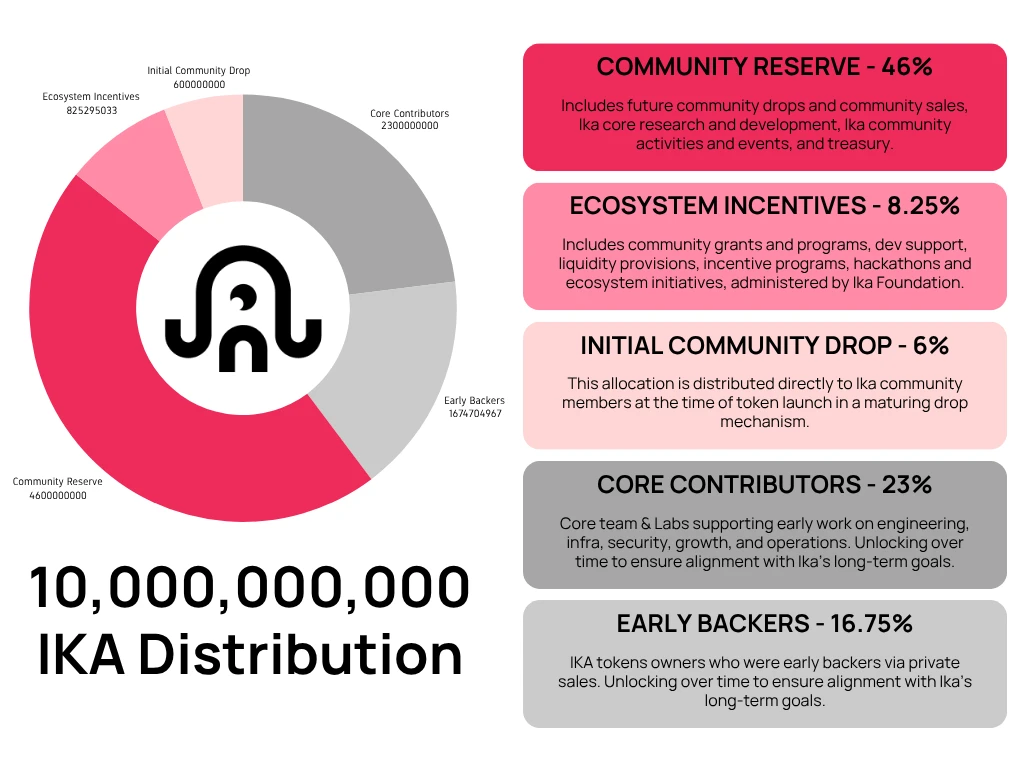
Allocation breakdown:
- Community allocation: 60%+
- Community drop at mainnet: 6% (600,000,000 tokens)
- Ecosystem incentives: 8.25% (825,295,033 tokens)
- Community treasury: 46% (4,600,000,000 tokens)
- Early Contributors: 23%
- Early Backers: Under 16.75%
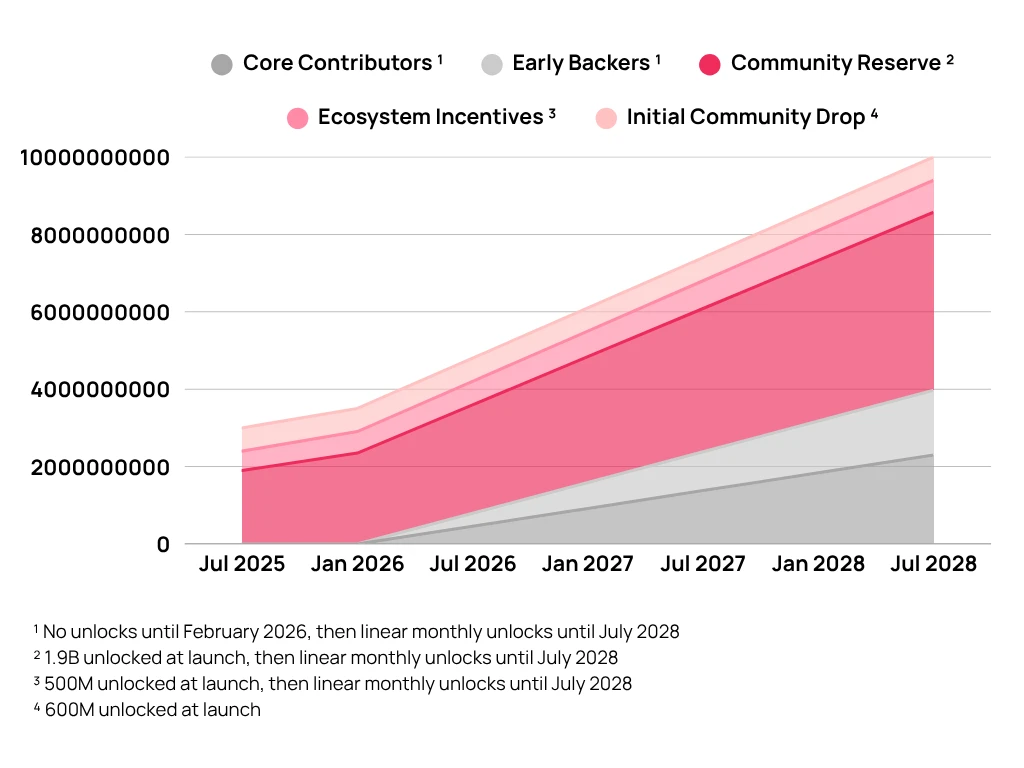
Release schedule: Three-year lockups for insiders with zero unlocks during first six months heavily favor community allocations.
Total supply increases through protocol-controlled minting for staking rewards and governance-determined purposes.